Advertisement


DI Press Brings New Opportunities

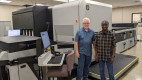
Despite a budget crunch and a state-wide ban on new equipment, this in-plant justified a new four-color direct imaging press.

November 2008

n

Ease of use. “It is especially difficult to find experienced press operators in Columbus,” he says. “I wanted to make sure we had an automated system that could be effectively operated by a less experienced operator, if necessary.”

n

Environmental sustainability. Bramlett wanted to minimize the use of chemistry and purchase a system that could operate with minimal waste.

n

Quality and fast turnaround. “In order to bring outsourced work back in-house and increase our value to the university, we needed a solution that could address the speed and quality requirements of our customers,” Bramlett says. “We also wanted something that could open up new application opportunities for us.”

It took Bramlett eight months to get his request for a four-color press approved by the university, between the paperwork, specification and bid development and the actual procurement process. As a result of his work, the shop was able to install the 34DI in July.

“It was not an easy sell,” Bramlett points out.” But now that it’s in, it’s been doing wonders.

“We have been able to bring virtually all outsourced four-color print back in-house,” he proclaims. “In the first two months, the 34DI press was already paying for itself.”

He says he’s also happy with the quality of the 34DI’s printing.

“We had issues before with trying to run four-color work on our two-color presses,” says Bramlett. “Now, with the on-press platemaking capabilities of the DI press, the registration is perfect and the quality is excellent.”

In June, Bramlett was able to hire an experienced press operator who had been out of the industry for a time.

“We were lucky to get him,” he says. “He ran one of the original DI presses from the 1990s for more than 10 years, and he was amazed at how far the technology has come with the 300-dpi quality and automation features of the current generation of DI presses.”

Bramlett and his team conducted an open house to educate university staff about the new capabilities.

“People were delighted with the environmentally friendly aspects of the press,” he recounts. “Chemistry-free platemaking, virtually no paper waste, and a significant reduction in the use of water all adds up to a reduced carbon footprint for us. Everyone came away impressed with the new capabilities, and saw our shop from a totally different perspective. There was a real ‘wow’ factor. We were also proud to be the first Georgia university to purchase a DI press.”

The ability to cost-effectively produce high-quality short runs is also opening new doors for the university and its Printing Services department. At the open house, the Athletic Department was very excited about the ability to produce projects that would otherwise have been unaffordable.

“We can produce printed materials at about half to two-thirds less the cost than our commercial counterparts,” Bramlett states. “The Athletic Department is thrilled with the ability to step up the quality of their media guides, pocket schedules and other materials without stepping up the cost.”

Growing School, Shrinking Staff

Bramlett also points out that the university is growing.

“When I started here,” he says, “we had 3,500 students. Now we have topped 8,000 students for the first time. We have to keep up with demand. Recruiting is going at full speed and we have to meet those needs. With our updated shop, we are well positioned to do so.”

Recently, one employee retired, and because of the budget situation, Bramlett has not been able to replace him.

“We are moving to four 10-hour days,” he reports, “with two press operators backing each other up on the Presstek DI press. That way we are able to achieve 50 hours of production time in a week instead of 40. However, I am looking forward to the time when I can grow head count, at least a little, especially in bindery. Bindery becomes a full-time position with the volume of four-color work we are now generating.”

The new press hasn’t taken over all the shop’s work, though.

“We have one ABDick 360 set up for business cards and one for envelopes, both using the university’s two-color logo,” Bramlett says. “We also produce envelopes on the ABDick 9835. Our copy department handles quick copy for things like stationery and exams.”

In general, the DI press produces any full-color work in runs of more than 300 to 400, with average runs being in the 1,000 to 2,000 range.

When asked what advice Bramlett would have for other managers in his position, he was quick to say, “You have to stay current with the technology and be creative about how you justify the investments. Had we not made this move to efficient four-color printing, I don’t know where we would be today. Maybe we would still be open; maybe not. Yet, with the university looking to cut spending, we might have been one of the first to go.

“We had basically turned into a glorified copy shop,” he says. “Now, with our new Presstek DI press, we are providing competitive printing services, and actually saving the university money. We are part of the solution, and that is a good place to be.”
 

Companies Mentioned:

COMMENTS

Most Recent Comments: