


In-Print 2024 Categories-Rules | 2024 Entry Form | Tips | Awards | Why You Should Enter
In-Print™ 2024: Enter Today
It’s time to enter In-Print™ 2024, the only printing contest exclusively for in-plants. Jointly sponsored by In-plant Impressions and the In-plant Printing and Mailing Association (IPMA), the contest is an excellent way to show off the quality of your printing. Not only does the contest have numerous categories for both “Offset” and “Non-Offset” pieces…
- There is a category for projects printed using both techniques.
- Six categories are open only to in-plants with 10 or fewer employees.
- There are categories for both variable data and cross-media projects.
- This year we have added eight new categories, three of those exclusively for small shops.
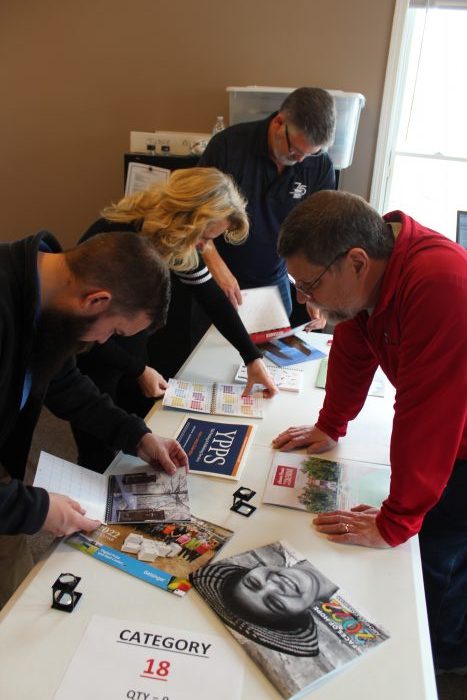
Judges pour over In-Print 2022 contest entries.
To speed up entry processing, we use an online entry form. You must fill out this form for each entry you submit, and include a copy of the confirmation number with your entries.
Entries must be registered online by February 16, 2024 and received no later than February 23, 2024, so start collecting samples now. Go through your printed work and pick out examples that are perfect in every way — great registration, crisp folds and no hickeys. Selecting flawless samples is the best way to ensure that your pieces make it through the first round of scrutiny by our eagle-eye judges.
Each year we receive hundreds of entries. The non-offset categories always receive the highest number of entries, particularly the booklets, flyers and special projects categories. Our judges examine each of them, weeding out those with cracked folds or bad registration, then select Gold, Silver and Bronze winners.
One Best of Show winner will be selected from the winners in the offset categories and another Best of Show winner will be picked from the non-offset categories. For a glimpse of what the judging is like watch this video. The winners’ names will be revealed at the awards dinner during IPMA’s conference, taking place in June.
Tips

Scenes from In-Print 2022 contest judging.
Over the years, the judges have provided a number of helpful tips on what makes a winning entry. One thing the judges love to scrutinize is the folds on entries to make sure both halves of the sheet line up perfectly. They often eliminate entries that are cracked along the folds because they were either folded against the grain or folded without first being scored. This is the most common reason pieces are eliminated. Also, many entries were eliminated in the past because poor quality copies were submitted, when better copies almost certainly existed.
Here are some other reasons that entries were thrown out. Did you have any of these problems with your entries?
- Holes and missing dots in solids, possibly due to a piece of dust landing on the plate during platemaking
- Spots and specks, especially in company logos
- Poor ink coverage
- Color variation from page to page, particularly noticeable in company logos or headers that appear on consecutive pages
- Color variation between stationery, envelopes and business cards
- On multi-page forms, the lines on each page must line up with those on other pages
- Out of register printing
- Front-to-back registration off
- Doubling: when ink from the first blanket transfers onto the second blanket and gets printed on the paper again as a ghost image
- Mottling: spotty, uneven printing in solid areas
- Too much powder used, which leaves a gritty, unpleasant feel on the paper
- Bad folds
- Track marks on paper
- Inserts that don’t fit together right
- Items placed in the wrong categories
- Design problems like: bad letter spacing; crooked lines of text; fuzzy photos
- Pages printed upside-down
On the entries in our non-offset categories, here are some of the problems judges encountered:
- Images were not centered
- Roller marks on page
- Color consistency changed from page to page
- The darkness of the toner in the text portions of the piece changed from page to page
- Unfolded press sheets were submitted, not a finished product

Scenes from In-Print 2022 contest judging.
One more tip: Pieces that include a number of different parts (e.g. a direct mail package filled with loose pages, or stationery submitted with a business card and envelope) have not fared well in the past. You increase the chance that the judges will find an error. It’s best to enter the single piece of which you are most proud.
For example: One in-plant entered a direct mail package filled with loose pages, some of which had enough blemishes to disqualify the whole entry. But if the pocket folder had been submitted by itself, the judges agreed, it would certainly have won in the folder category. So pick your categories wisely. And simplify.
Often, many in-plants enter the contest right at the deadline. As a result, they don’t properly inspect their entries and submit the best copies. This has cost several in-plants prizes, since if they had only sent a copy with better folds and crossovers, they would have won. Instead they were eliminated. Many items have been tossed out for infractions as small as a missing dot in the middle of a solid, or cracking on a fold that hadn’t been scored.
You should examine all four copies of your entries in detail–don’t just grab any four from the top of the shelf. Look at the folds and registration. Are they perfect? Are there any visible hickeys? Look carefully, because if you don’t take the time to scrutinize your entries, be assured, our judges will.

The judges inspect some of the wide-format entries in the In-Print 2022 contest.
The best advice is to get your press operators involved. Show them the entry form when it first appears each November. Get them interested in saving flawless samples–and put them aside far in advance of the deadline.
Also, and this is extremely important, when filling out the entry form, please check the correct category. A brochure is not a folder. Don’t put offset pieces in the digital category, or mistakenly enter a category for small shops if yours is a large shop. When judging day comes and the judges see your piece in the wrong category, it may be disqualified — especially if they have already judged the correct category.
Awards
In-Print winners will receive elegant plaques, which will be presented at the next IPMA conference. From all of the Gold Award winners, the judges will pick one Best of Show winner from the offset categories and one Best of Show from the non-offset categories. Those in-plants will receive trophies during the IPMA Awards Banquet.
Here’s a list of Best of Show winners through the years. (Since 2010, we have awarded a Best of Show for offset-printed pieces and another for those printed using non-offset processes.)
- 2023 – Government Publishing Office/Oregon State University
- 2022 – University of Nebraska – Lincoln/Oregon State University
- 2021 – University of Oklahoma/University of Pittsburgh
- 2020 – Bloomberg/University of Texas at Austin
- 2019 – Church of Scientology International/World Bank
- 2018 – Bloomberg/University of Texas at Austin
- 2017 – Bloomberg/University of Texas at Austin
- 2016 – Church of Scientology International/Yale University
- 2015 – Brigham Young University/Excellus BlueCross BlueShield
- 2014 – Brigham Young University/East Carolina University
- 2013 – Church of Jesus Christ of LDS/Washington State University
- 2012 – University of Minnesota/University of North Texas
- 2011 – Brigham Young University/University of North Texas
- 2010 – University of Oklahoma/University of North Texas
- 2009 – Briggs & Stratton
- 2008 – Conoco Phillips
- 2007 – Conoco Phillips
- 2006 – University of Delaware
- 2005 – University of Missouri-Columbia
- 2004 – University of Delaware
- 2003 – University of Missouri-Columbia
- 2002 – Phillips Petroleum
- 2001 – Boeing
- 2000 – SAFECO
- 1999 – University of Missouri-Columbia
- 1998 – Hitachi Data Systems
- 1997 – Boeing
- 1996 – Phillips Petroleum
- 1995 – Brigham Young University
- 1994 – Phillips Petroleum
- 1993 – Boeing
- 1992 – USAA
- 1991 – Boeing
- 1990 – Boeing

